


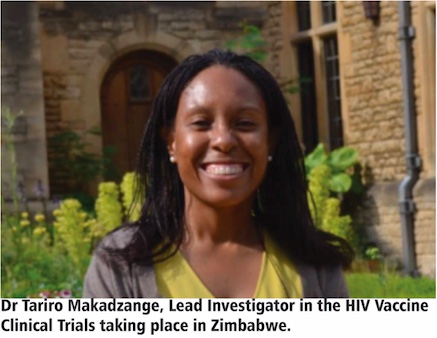
In this second part, The Masvingo Mirror had an exclusive interview with Dr Tariro Makadzange, MD PhD, Director and Founder of Mutala Trust /ACRN which is carrying out an HIV Vaccine Clinical Trial. Dr Tariro Makadzange is the Principal Investigator. The purpose was to understand why people already living with HIV were participants in the study.
Question: What is the significance of the gorilla adenovirus vector?
Dr Makadzange: The GRAdHIVNE1 vaccine uses a harmless adenovirus as a carrier for HIV vaccine components. Adenoviruses are the family of viruses that can cause common colds, and because many people already have immunity to human adenoviruses, vaccines using them may not work as well. To avoid this, researchers use adenoviruses from other primates such as chimpanzees (like one of the COVID-19 vaccines) or gorillas, which people have not been exposed to. This allows the immune system to respond more strongly. These viral carriers are particularly good at stimulating immune defences such as T cell responses. While many different HIV vaccine strategies are being explored worldwide, this is one of the promising approaches.

Question: This HIV Clinical Trial includes people living with HIV. Why?
Dr Makadzange: This early-stage trial involves both individuals without HIV and people living with HIV who are stable and have their virus well controlled with antiretroviral therapy (ART). In HIV infection, the virus changes very rapidly, which makes it difficult for the immune system to keep up. Over time, the immune response tends to weaken and mainly targets parts of the virus that change a lot, rather than the more stable parts. By including people living with HIV in this study, researchers hope to see whether the vaccine can stimulate immune responses to the more stable regions of the virus called networked epitopes. If successful, this could point toward future strategies that help the immune system control HIV more effectively, even in people already living with the virus.
Question: What are the storage and handling requirements of the vaccine?
Dr Makadzange: Currently, the vaccine is stored and handled under standard trial conditions using refrigeration and established cold-chain systems. Future considerations for wider distribution, especially in resource limited settings, will be assessed as research progresses.
Question: What are the dosing regimens?
Dr Makadzange: In the early stages of vaccine research, one of the key questions is how the immune system responds to different dosing schedules, how many doses are needed, how far apart they should be given, and whether boosters might be required later. This Phase 1 study gives participants two doses of the vaccine at set intervals to begin answering these questions. At this stage, the focus is on safety and understanding the immune response. Determining the best long-term dosing approach will require additional, larger studies in the future.
Question: What is the cost and accessibility?
Dr Makadzange: Because this is still an early-stage trial, it is too soon to estimate the eventual cost of the vaccine. The immediate focus is on understanding safety and immune responses. However, funders and partners in this field have consistently emphasized that new HIV prevention tools be designed with low- and middle-income countries (LMICs) in mind. If the vaccine proves successful, ensuring equitable access and affordability in the regions most affected by HIV will remain a central priority.
Question: Can you speak into safety measures
Dr Makadzange: Participant safety is the top priority in any clinical trial. These studies are tightly regulated and follow international and national standards. In practice, this means:
Close medical follow-up: Participants attend multiple scheduled visits, where they are assessed by doctors and nurses and have regular laboratory tests.
Ongoing monitoring: People living with HIV continue their regular treatment (ART) and are monitored closely to ensure their health is not compromised.
Rapid response to side effects: If any symptoms or side effects occur, participants have immediate access to medical practitioners, and all events are carefully documented, treated, and reported to regulators.
Independent oversight: An independent safety review board regularly examines the data to ensure that participants remain safe throughout the trial.
Question: Speak more into scientific value of including people living with HIV, as an affected, I am keen to learn more.
Dr Makadzange: Including people living with HIV in this early study is very important. HIV changes quickly inside the body, which weakens the immune system s ability to keep up. Over time, the immune system often targets parts of the virus that change the most, instead of the parts that stay stable. By studying people who are stable and on effective treatment, researchers can test whether the vaccine can help redirect the immune response toward these more stable regions of the virus.
If successful, this could open the door to new strategies where vaccines work alongside other strategies to strengthen long-term immune control of HIV. In short, including people living with HIV allows us to ask whether vaccines can teach the immune system to respond more effectively to the virus, even after infection has already occurred.
Question: I hear that despite being virally suppressed, there is an HIV reservoir.
Dr Makadzange: One of the biggest challenges in curing HIV is something called the HIV reservoir. When a person is infected, HIV hides inside certain long-lived cells in the body. Even though antiretroviral therapy (ART) can suppress the virus to undetectable levels in the blood, these hidden copies remain asleep inside the reservoir. If treatment is stopped, the virus can wake up and start reproducing again.
This is why ART controls HIV but does not cure it. The vaccine being tested in this study is not designed to eliminate the reservoir. Instead, it may provide insights that help scientists understand how the immune system could one day be guided to target these hidden cells as part of broader strategies toward long-term remission or cure.
Question: Adverse event protocols, tell us how these will be handled?
Dr Makadzange: Safety is built into every step of a clinical trial. If a participant experiences any symptom or side effect called an adverse event, it is immediately documented, carefully evaluated, and treated as needed. Participants have direct access to medical staff throughout the study, and these events are reported to national regulators and ethics committees.
In addition to close monitoring at each study site, there are multiple layers of oversight. A Protocol
Safety Review Committee reviews safety across all the trial sites, and an independent Data and Safety Monitoring Board (DSMB) regularly evaluates the data to ensure the trial remains safe. These safeguards apply equally to participants with and without HIV.
Question: Shed light on research study sample size and next phases
Dr Makadzange: Phase 1 studies are intentionally small around 120 participants to carefully evaluate safety and immune responses. If the findings are promising, larger Phase 2 and Phase 3 studies would involve more participants to evaluate effectiveness on a broader scale.
We hope these responses provide clarity. Thank you again for your engagement and commitment to informing the public about ongoing HIV vaccine research.
About the Collaborating Institutions in this HIV Vaccine Clinical Trial.
Mutala Trust is founding member of Africa Clinical Research Network (ACRN) and is a site based in Harare, Zimbabwe. It is known for conducting high-quality, ethically sound clinical trials addressing diseases that affect African communities. Mutala is the clinical lead site for the study..
Desmond Tutu Health Foundation (South Africa) is a pioneer in community-based HIV prevention and treatment research, with a strong track record in clinical trials.
Africa Health Research Institute (South Africa) combines population studies, clinical trials, and lab science to inform health solutions in South Africa and beyond.
Cape Town HVTN Immunology Laboratory (South Africa) specialised laboratory for the analysis of immune responses to candidate vaccines.
National Institute for Communicable Diseases (South Africa) is South Africa reference center for surveillance, diagnostics and research on infectious diseases providing advanced laboratory support vaccine trials.
IAVI is a global nonprofit scientific research organization developing vaccines and antibodies for HIV, tuberculosis, and emerging infectious diseases.
ReiThera is an Italian biotech company with expertise in viral vector vaccine production.
The Ragon Institute of MGH, MIT, and Harvard is a leader in immunology and virology research focused on understanding immune protection and guiding vaccine design.
Feedback: [email protected]

https://farmaciabesurica.shop/# acquisto farmaci a domicilio Italia
classifica farmacie online: Farmacia Besurica – top farmacia online
I’m truloy enjoing thee dessign and layout off your website.
It’s a veery eaey oon the eyes whioch maskes itt muh molre ppleasant ffor mme tto clme here andd visut mor often. Diid yyou hiree ouut a desiger to creeate
your theme? Exceptional work! xnxx