MORRIS BISHI
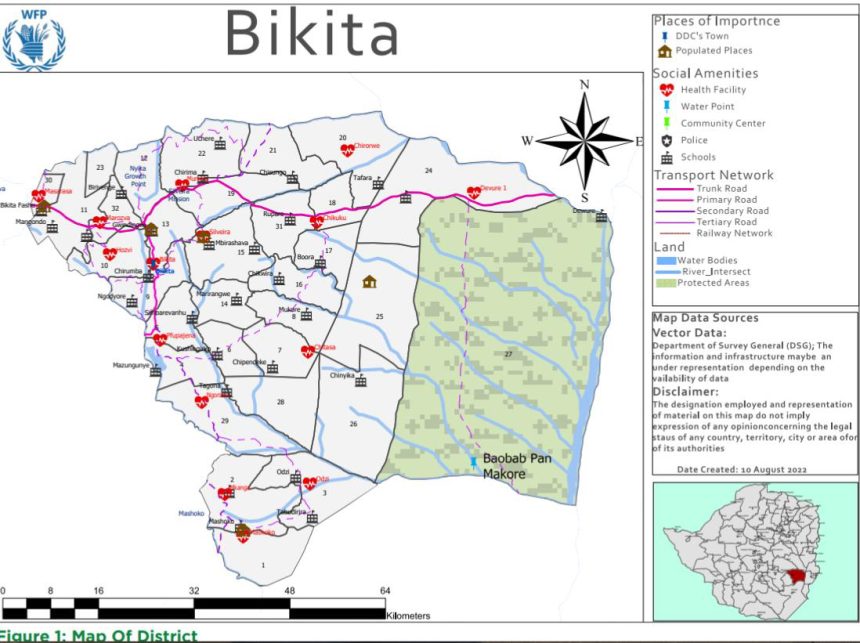
BIKITA – Bikita district is one of the seven districts that make up Masvingo province.
It lies about 80km east of Masvingo City along the Masvingo-Birchenough Bridge Highway. Covering 5 286 square kilometres, it is one of the province’s largest districts.
The district shares boundaries with Gutu, Zaka, Masvingo, Chiredzi, Chipinge and Buhera districts. Its strategic location places it on a key transport corridor linking the eastern and southern parts of Zimbabwe.
According to the 2022 Population and Housing Census, Bikita has a population of 176 835 people. The district experiences a subtropical semi-arid climate, with most of it falling under natural regions 3, 4 and 5. The dominant languages spoken are Shona, Ndau, English and Sign Language.
Administratively, Bikita Rural District Council oversees 32 wards. These comprise 24 communal wards, three resettlement wards, three small-scale commercial farming wards, one large-scale commercial farming ward and one mining ward. Nyika Growth Point serves as the council’s administrative headquarters and principal service centre.
The district’s administration is shared between two centres. While BRDC is headquartered at Nyika Growth Point, several key government institutions, including the Magistrates Court, the ZRP main police station and other government departments, operate from Bikita Business Centre, making both centres important hubs for public service delivery.
The council operates under the Rural District Councils Act and is responsible for planning and coordinating development across the district. Policy decisions are made by a 42 member full council headed by the Council Chairperson. Implementation is overseen by the Chief Executive Officer through six council departments.
The council also works closely with Government ministries, development partners and community structures in implementing development programmes. This collaborative approach has become central to the district’s development agenda.
Development planning follows a bottom-up approach. It begins at village level through Village Development Committees (VIDCOs), before moving to Ward Development Committees (WADCOs). Priorities are then incorporated into the district development plan, ensuring communities play a central role in shaping local development.
Chief Executive Officer, Arnold Mtuke said Bikita’s strategic location, sound governance structures and active community participation continue to position the district for sustainable development.
“Bikita is a district with a rich heritage and resilient communities. As council, we are committed to delivering quality services and fostering inclusive development that improves the lives of our people. Through sound governance, community participation and strategic planning, we are building a strong foundation for a prosperous Bikita in line with Vision 2030,” said Mtuke.
The council’s vision is to deliver excellent service by 2030 through good governance, transparency, accountability and inclusive development. Its planning framework is aligned with the National Development Strategy 2 (2026-2030) and Zimbabwe’s Vision 2030, reflecting its commitment to sustainable local development.