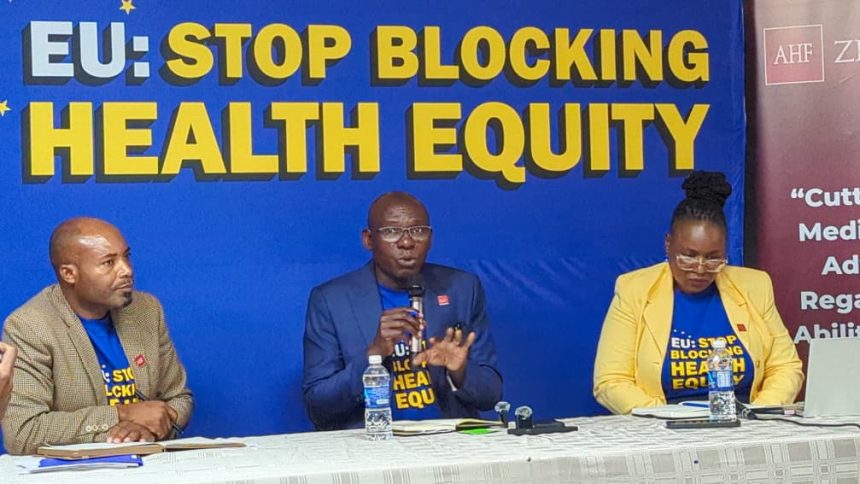
In a powerful demonstration of health advocacy in Harare, the AIDS Healthcare Foundation (AHF) Zimbabwe has officially challenged the European Commission’s resistance to a legally binding Pathogen Access and Benefit-Sharing (PABS) Annex within the World Health Organisation (WHO) Pandemic Agreement.
As the global community inches toward a critical May 2026 deadline, AHF Zimbabwe is urging international decision-makers to move beyond diplomatic rhetoric and prioritise health equity as a non-negotiable pillar of global security.
The PABS system is essentially a “fair trade” mechanism designed to prevent the chaotic, nationalistic responses that characterised previous global health crises. Under this framework, countries, mainly those in the Global South, share pathogen samples and genetic sequence data vital for scientists to understand emerging viral threats. In return, these countries are guaranteed a fair share of the “benefits” derived from that data: life-saving vaccines, diagnostics, and treatments, known collectively in technical circles as Medical Countermeasures (MCMs).
However, the European Commission, alongside powerful nations such as Germany and Switzerland, has been accused of blocking these mandatory provisions. They appear to favour a system that protects the commercial interests of pharmaceutical giants over the survival of vulnerable populations in developing nations.
The global village was decimated by COVID-19. It remains as a stark warning of health inequality from the recent past.
The urgency of AHF’s demand is rooted in the bitter lessons of the very recent past. With the 2026 deadline for the finalisation of the Pandemic Agreement looming, the organisation warns that a weak or voluntary Annex risks repeating the devastating inequities of the COVID-19 era.
During that period, the world witnessed “vaccine apartheid” where wealth determined who lived and who died.
Dr Ernest Chikwati, the AHF Zimbabwe Country Director, provided a sobering reminder of the high stakes involved for low- and middle-income countries (LMICs). During the height of the last pandemic, the “Global North” was characterised by vaccine hoarding, while the “Global South” faced a dire scarcity of even the most basic medical tools.
”During COVID-19, we saw an inhumane situation where countries in the Global North hoarded vaccines. Some had more doses than they needed, while people in other parts of the world were dying without access,” Dr Chikwati stated.
“That is the inequality this agreement is supposed to address so that we are better prepared for future pandemics.”
For Zimbabwe and its regional neighbours, the PABS Annex is not merely a technical document; it is a shield against future marginalisation. AHF argues that without “teeth” in the framework, specifically legally binding contracts, wealthy nations will once again monopolise access to Medical Countermeasures, undermining the efforts of developing nations to build regional manufacturing capacity and achieve genuine health sovereignty.
The Pillars of Equity must go beyond symbolic gestures.
The AIDS Healthcare Foundation maintains a firm stance: “Equity cannot be optional.”
The organisation contends that any global pandemic agreement must force a direct, legal link between commercial profit and systemic contribution. This stance was echoed by Dr Sandra Bote, AHF’s Public Health Specialist. She argued that the current reliance on “voluntary” contributions has failed to secure global safety.
”Those who profit from the system must contribute to the system. Participating manufacturers and all commercial users must be subject to mandatory benefit-sharing with real accountability and legal certainty through binding contracts,” Dr Bote insisted.
According to Dr Bote, true equity goes beyond high-level promises or the “symbolic gestures of tokenism” that have defined global health for decades.
She identified several non-negotiable pillars that must form the foundation of a functional PABS system to ensure the fair distribution of Medical Countermeasures:
Tangible Resources: There must be a guaranteed, set percentage of pandemic-related products, vaccines, tests, and medicines. These must be reserved for equitable distribution to LMICs in real-time, not as an afterthought or a donation of “leftovers.”
Localised Power: The agreement must include mandatory technology transfers. This empowers regions like Africa to move away from external dependence and toward self-sufficiency by manufacturing their own high-quality pharmaceuticals.
Sustained Funding: Mandatory financial contributions from commercial entities that benefit from shared pathogen data are necessary to bolster global preparedness, surveillance, and response infrastructure in the South.
The Transparency Gap and Biosecurity
One of the most contentious points in the current negotiations is the issue of data transparency.
AHF and other advocacy groups have raised alarms regarding “anonymous access” to pathogen genetic data. Dr Bote warned that if the system allows users to access sensitive genetic information without identifying themselves or their intentions, the entire framework of accountability collapses.
”If we do not know who is accessing the system, we cannot hold them accountable. Anonymous access compromises the integrity of the system and creates real biosecurity concerns,” she warned.
Without a clear ‘paper trail’ of who is using shared data, it becomes impossible to track whether those users are fulfilling their benefit-sharing obligations. Transparency is not just a bureaucratic requirement; it is a safeguard against the extractive exploitation of biological resources.
A Tug-of-War for Global Governance
The debate over the PABS Annex reflects a larger, historical struggle in global health: cooperation versus control.
“For decades, global health governance has often felt extractive, with the Global South providing the data and the raw materials, while the Global North reaps the financial and health rewards,” she pointed out.
Civil society groups present in Harare joined AHF in demanding an inclusive and transparent negotiation process. They argue that the Global South is no longer interested in “charity.” Instead, they are seeking equitable partnerships based on mutual respect and legal certainty. The message from public health experts is clear: if the Pandemic Agreement does not guarantee equity, it is not an agreement worth signing.
The inclusion of this is pivotal. It is a race against time.
The AHF Global Public Health Institute continues to advocate for evidence-based policy changes that focus on strengthening health systems worldwide.
As the largest non-profit provider of HIV/AIDS medical care globally, AHF’s perspective is grounded in the daily reality of clinical care in underserved communities.
As the clock ticks toward May 2026, the pressure on the European Commission and its allies is mounting.
The choice before them is stark: uphold a system of commercial exclusivity that leaves the world vulnerable to the next pathogen, or embrace a legally binding framework of equity that protects everyone.
For AHF Zimbabwe, the goal is a more equitable global health architecture that leaves no country and no community behind.
● Feedback: [email protected]
#AHFZimtacklesEU
AHF Zimbabwe Demands EU Respect Equity in WHO Pandemic Agreement