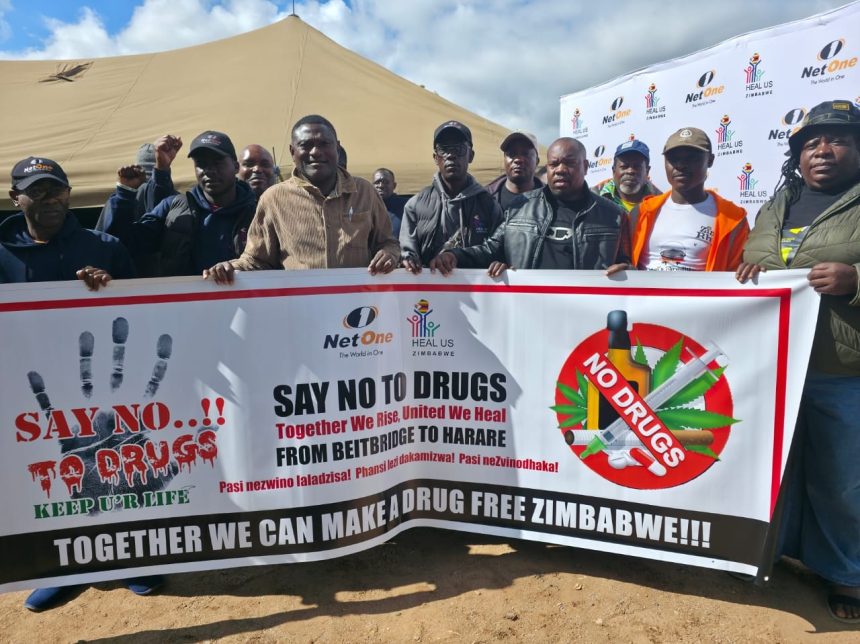
On June 27, Matabeleland South Provincial Minister Albert Nguluvhe flagged off the Heal Us Zimbabwe (HUZ) team from Beitbridge Primary School. The crew embarked on an ambitious 600km awareness walkathon from Beitbridge to Harare, weaving through rural villages and urban centres to engage communities in a critical fight against drug and substance abuse.
Beitbridge to Harare is 580km, however, the crew would not sleep by the roadside. They would walk into the community to rest overnight at designed places.
For the final 18km lap into the capital city Harare, Adian Mushore, aged 15 joined his dad and crew in the walk of honour.
HUZ, the brainchild of Columbus Tapiwa Mushore, a substance survivor turned advocate, was established to combat the escalating menace of dangerous substances like crystal methamphetamine and many drugs and other harmful substances when misused.
Working alongside fellow recovering addicts Terrence Shenje and Kudakwashe Mafuta, Mushore’s initiative aims to connect active users with rehabilitation services and spark vital, open conversations about addiction.
Along the journey, the HUZ team traversed Chinyu village, engaged with Mwenezi District road construction workers, and actively participated in the Chivi South Inter-District Sports Day at Maringire Primary School.
Supported by mobile telecommunications giant NetOne, the expedition was initially slated to last 23 days. However, the energetic crew arrived three days ahead of schedule, setting foot at Africa Unity Square in Harare on Wednesday, July 15, to a thunderous welcome from locals and NetOne staff.
Walking under the theme “Together We Rise, United We Heal,” the campaign emphasizes collaboration.
At the launch of the initiative, NetOne Group Chief Executive Officer, Engineer Raphael Mushanawani, highlighted the necessity of unity across government, private, and civil sectors.
“We are running towards a future where our youth reject substance abuse,” Eng Mushanawani said.
“Heal Us Zimbabwe brings the lived experience, the frontline truth, and the human face of recovery.”
HUZ crew is a voice from the frontline.
The walkathon served as a journey from the depths of addiction to the frontline of a national movement. For 22-year-old Terrence Shenje, addiction derailed a promising football career at just 17. “Coming from the ghetto, I succumbed to peer pressure,” he recounted, hoping his story acts as a stark warning to other youths.
Mushore expressed profound gratitude for the reception the team received on the road.
“Motorists would stop or hoot, cheering us up, and locals at shopping centers were eager to join our anti-scourge advocacy,” he noted.
Similarly, Kudakwashe Mafuta, who quit using mbanje in 2020 after developing lung and kidney disease, warned that the crisis has deeply penetrated rural areas.
“There is no benefit whatsoever; you just destroy yourself for short-time gratification. I realised that it is no longer a ghetto challenge. Along the way, we witnessed some who were a mirror of my former self,” Mafuta cautioned.
HUZ is moving forward with Vision 2030, echoing the sentiments of shared responsibility, NetOne’s Public Relations Officer, Thamsanqa Luphahla, emphasized the telecom company’s commitment to building healthy communities in line with the nation’s Vision 2030.
“As we partner with the government, we must make sure our communities are healthy. We are not just a commercial entity; we need to plough back,” Luphahla stated.
Mushore emphasisedthat fighting the scourge is an everyday initiative.
“Every step in our walk will heal Zimbabwe’s youths from drug and substance abuse. Let us all play our part in raising awareness 365”.
Building on the momentum of this third successful campaign, Heal Us Zimbabwe is now focused on mobilising support and raising funds to establish a dedicated drug rehabilitation center that will offer free services to Zimbabweans battling addiction.
According to research, drivers of drug abuse include peer pressure, broken families, meer mischief to experiment, emotional and physical abuse, often resulting in the one-time-test growing into addiction.
But there is also another driver, pop culture. Young people in Africa are hooked onto television where film and music stars glorify drug usage. The popular culture depicts drug usage as a positive thing and a key ingredient to having fun.
In the mix, is also violence and sex.
According to a World Health Organization (WHO) 2021 Report, Zimbabwe has the highest rate of 15 to 19-year-olds engaging in heavy “episodic drinking” in Africa, with 70.7 percent of males and 55.5 percent of females participating.
Unfortunately, this age group is also heavily involved in drug dealing and use.
These are worrying signs. Not least, drug usage has been linked to HIV and Aids, a battle that was thought to be won by Government but could now be fuelled by the drug crisis.
Fighting the cancerous effects requires all hands on the deck.
Feedback: [email protected]