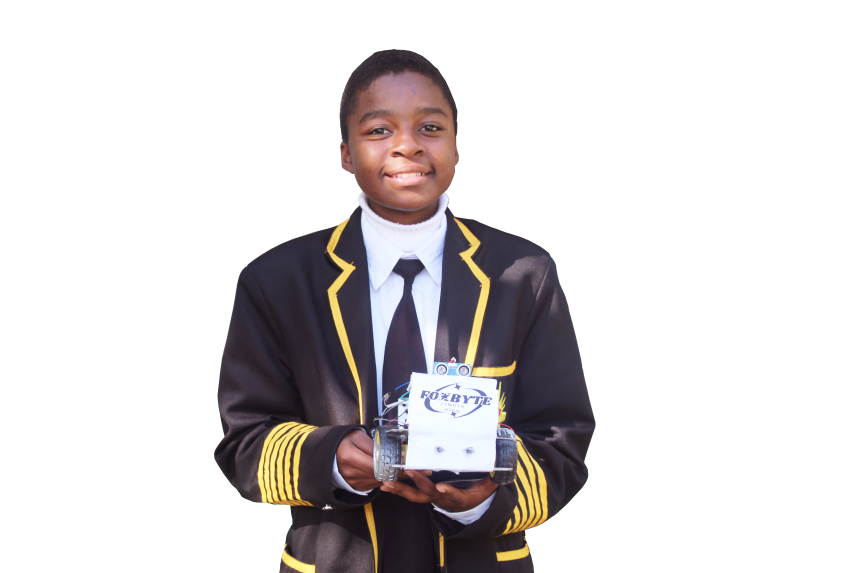
MASVINGO – Zimuto High robotics students led by Ashley Makonese have invented Geendah 2.0, a robot that detects dangerous gases in mines and diffuse them before they affect workers.
This is not the first time that the school made headlines with its innovations. In 2024, Theophilus Beans, Eustine Muvoti and Flint Shamba won gold at the World Robotics Olympiad Zimbabwe 2024 and represented the country in Turkey.
Another former student, Tinomudaishe Gwehama got recognition at the Space Physics and Astronomy Olympiads in Russia where he was recognised by Russian President Vladimir Putin.
Due to Gwehama’s innovation, Zimbabwe was on position 1 in Africa interms of innovation and 34 on world record.
Geendah comes in handy for artisanal and small-scale miners who cannot afford imported equipment used by large mines.
It is designed to move through mine tunnels, detecting and absorbing toxic gases such as carbon monoxide and methane.
“Robotics is male dominated but girls can also do great things there. It is not only about cooking.
Girls can innovate and transform communities through technology,” said Ashley Makonese.
Geendah 2.0 is an upgrade of the Toxic Gas Detector Machine invented by students as it is also able to detect the presence of mineral deposits underground. Zimuto High head, Langton Chikaka said the school continues to excel in robotics and innovation.
Makonese is appealing for funding to work on more innovations.
Geendah 2.0 was invented in April this year.
“Apart from Geendah 2.0, the school already has other innovations like the Smart Walking Stick for the visually impaired (2023), the Toxic Gas Detector Machine and the Cyber Bully Defender (2025),” Chikaka said.
Geendah 2.0 was designed by Makonese and several other members of the school robotics club who include Praise Pabwe, Pfuluphelo Singo, Nokutenda Manasidze, Evelyn Rwakonda and Madhlazi Blessing.
They are mentored by Science and Robotics teacher, Vincent Gonese.
Makonese, an Upper 6 Mathematics, Physics and Computer Science student said the invention was inspired by the dangerous conditions faced by artisanal and small-scale miners who often lack proper safety equipment.
“We saw that big mines have machines that add oxygen in mines and ensure miners have quality air to breathe. Small scale miners have no funds to buy expensive machines, so we designed a smaller and cheaper robot that can work in local mines. The robot combines both safety and productivity, addressing life-threatening risks and operational needs,” said Makonese.
The robot purifies contaminated air using activated carbon filters, helping improve air quality in mining shafts.
It is equipped with an ultrasonic sensor which helps it detect obstacles and change direction while navigating underground tunnels.
“The robot has an ultrasonic sensor which notifies it when it comes too close to an object so that it can change route and move properly.
“When the robot comes across metallic minerals, it makes a buzzer sound to alert miners about the presence of minerals,” said Makonese.
She encouraged more girls to venture into robotics and science-related fields.