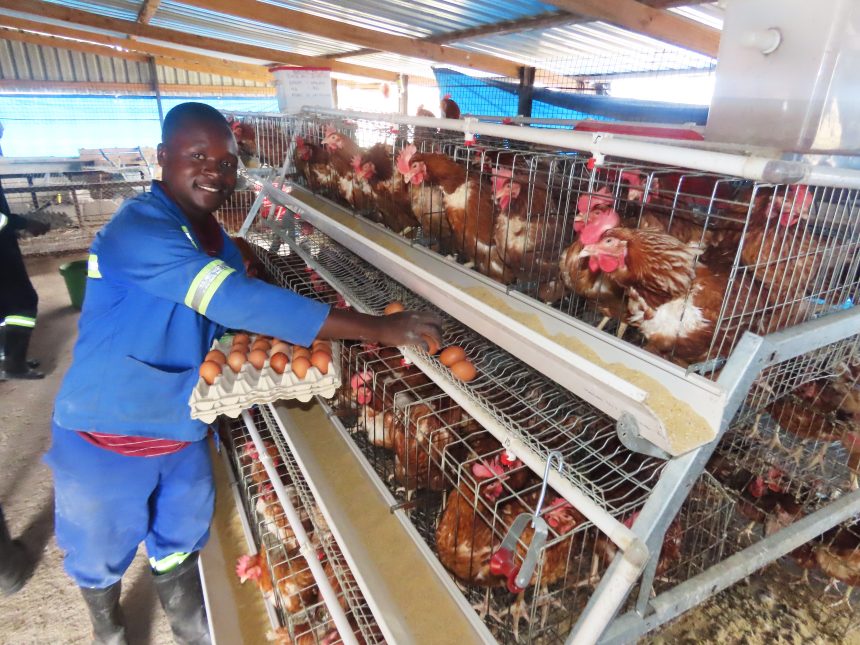
GUTU – Agricultural practice at the Churches of Christ run Living Proof High in Serima has significantly improved the school’s food self-sufficiency.
The school which is located on a 65 hectare piece of land runs dairy and beef, market gardening and poultry projects. The agricultural projects are integrated with waste from one project being used in the other projects i.e chicken and cattle manure are used in the garden.
The school has 10 herd of cattle including beef and dairy. The agricultural department runs a poultry project where broilers are kept for meat while layers produce eggs.
The projects ensure that the school gets its milk, vegetables eggs and chicken from the agricultural department.
The projects are valuable for agricultural students and last year they got 100% in the Cambridge exams.
The Agriculture Department is headed by Michael Mashapa.
The horticulture section covers 1.5 hectares and produces tomatoes, cabbages, green peppers, lettuce, peas, beans, okra, maize and watermelons using efficient irrigation systems.
Mashapa told Masvingo Mirror in an interview that the projects, which were initiated in 2023, have developed into a model of agricultural sustainability.
The school’s agricultural model is built around efficient resource utilisation, with crop residues, vegetable trimmings and surplus used for livestock feed.
“For tillage, we use our own tractor for land preparation, which means we do not depend on external draft power. We also have sprinkler irrigation systems that help us water crops effectively,” said Mashapa.
Mashapa, who holds a Certificate in Agriculture, a Certificate in Education and a Bachelor of Education Degree in Agriculture, joined Living Proof High School in 2025.
Form 4 pupil Khaliwe Chimuka said the projects give learners valuable hands-on experience in modern farming despite the area’s challenging climatic conditions.
“Our school is located in a frosty area, but we successfully grow crops such as watermelons, cabbages, tomatoes, green peppers, maize, lettuce, peas and beans. We use different irrigation methods, including sprinkler irrigation, drip irrigation, rain-gun systems and centre pivots,” said Chimuka.